- Details
-
Published: 03 July 2026
Efficient Water Recycling Solution for Domestic Food Processing Plants
In modern food processing plants, especially potato chip and pre-cut potato slice production lines, large volumes of flushing water are generated during washing and cutting processes. This wastewater typically contains a significant amount of free starch, fine fibers, and suspended solids.
Instead of discharging this valuable stream as waste, a decanter centrifuge can be used to efficiently recover starch and enable water recycling, significantly reducing operating cost and environmental load.
1. Application Overview: Potato Slice Flushing Water Treatment
During potato slicing and washing, starch is continuously released into process water. This “flushing water” generally contains:
- Free potato starch particles
- Fine fiber and pulp residues
- Suspended organic solids
- High turbidity process water
If untreated, this water cannot be reused and increases both freshwater consumption and wastewater discharge costs.
By integrating a decanter centrifuge system, the plant can achieve:
- Continuous starch recovery
- Clarified water reuse
- Reduced wastewater treatment load
- Improved overall process sustainability
2. Separation Principle of the Decanter Centrifuge
The decanter centrifuge operates on the principle of high-speed centrifugal sedimentation.
Inside the rotating bowl:
- Feed slurry is introduced continuously through the inlet zone
- Centrifugal force separates components by density
- Heavy phase: starch and solids move to the bowl wall
- Light phase: clarified water remains in the center
- A screw conveyor (scroll) continuously transports solids to the discharge outlet
- Separated liquid is discharged through a separate outlet
This process enables continuous, automatic, and efficient solid-liquid separation without filter media.
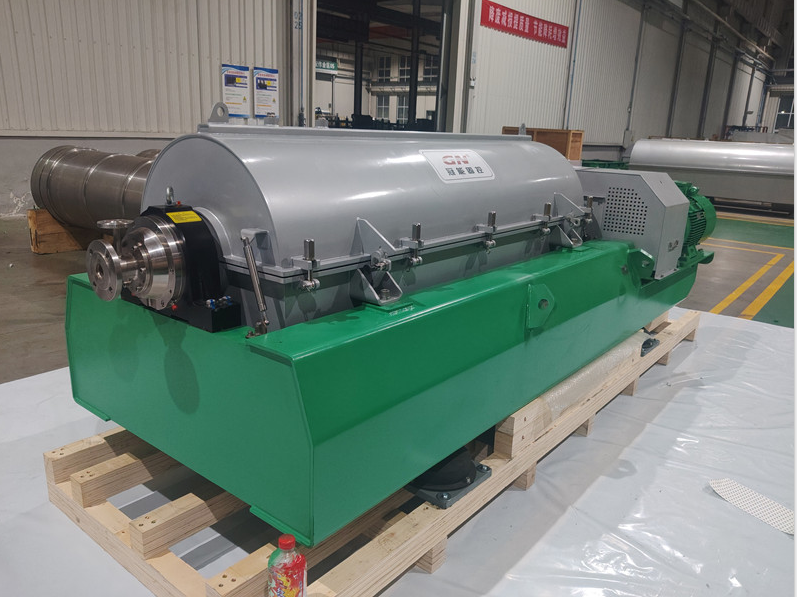
3. Equipment Introduction: Decanter Centrifuge
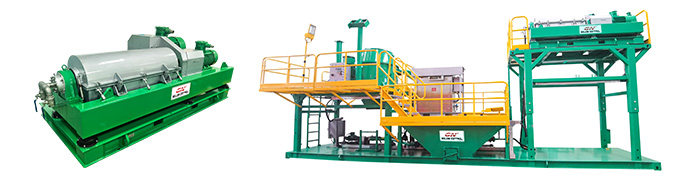
A decanter centrifuge is a horizontal, solid-bowl separation machine widely used in food processing, wastewater treatment, and starch recovery applications.
Typical features include:
- Continuous operation (24/7 capability)
- High separation efficiency for fine particles
- Adjustable differential speed for optimized dryness
- Wear-resistant design for abrasive slurry
- Compact footprint compared to sedimentation tanks
- Fully automated PLC control system
4. Key Advantages in Potato Processing Applications
When applied to potato slices flushing water, the decanter centrifuge offers significant benefits:
4.1 High Starch Recovery Rate
Fine starch particles that would normally be lost in wastewater are efficiently recovered, improving raw material utilization.
4.2 Water Recycling Capability
The clarified liquid phase can be reused directly in washing or preliminary cleaning stages, reducing freshwater demand.
4.3 Reduced Environmental Load
Lower suspended solids (TSS) in discharged water reduces wastewater treatment costs and environmental impact.
4.4 Stable Continuous Operation
Unlike filtration systems, the decanter centrifuge operates continuously without clogging or filter replacement.
5. Process Integration in a Potato Slice Plant
A typical integration scheme is as follows:
Potato slicing & washing → Flushing water tank → Feed pump → Decanter centrifuge →
- Outlet 1: Recovered starch slurry (for further processing or by-product use)
- Outlet 2: Clarified water (reused in washing system or sent to treatment)
This creates a closed-loop water system, improving plant efficiency.
6. GN Separation Decanter Centrifuge Solution
GN Separation provides industrial decanter centrifuge systems designed for food and starch-related applications, including potato processing wastewater and starch recovery.
Key engineering highlights include:
- High G-force separation for fine starch recovery
- Duplex stainless steel construction for corrosion resistance
- Optimized bowl and scroll design for high solids handling
- Adjustable operational parameters for different feed conditions
- Low energy consumption and high automation level
More technical details can be found here:
https://www.gnseparation.com/dewatering-decanter-centrifuge
7. Conclusion
The application of a decanter centrifuge in potato slices flushing water treatment provides a practical and highly efficient solution for modern food factories.
It enables:
- Valuable starch recovery
- Significant water reuse
- Lower wastewater treatment costs
- Improved environmental compliance
As water scarcity and sustainability requirements increase globally, decanter centrifuge technology is becoming an essential part of modern food processing infrastructure.